Monday, 15 August 2011

Iguazu Falls, Brazil


After a long and tring 55 hour bus journey from Salvador I was relieved to arrive in the infamous Foz De Iguazu. Based on what I had read, and other travellers´ photos and experiences, I was expecting to be extremely impressed with Iguazu Falls. What I was not prepared for was how overwhelmingly magnificant the falls actually are.

We had a short walk through a noisy, wildlife covered slice of jungle to enter the falls. Bold butterflies of every size, colour and pattern fluttered around us and along the way we were able to see bitesized pieces of the incredible falls.

As we got closer to the waterfalls the thunderous roar became louder and we could feel the water spray on our faces. It wasn´t until we got to the view point that we could see the grand-scale of the amazing rainbow covered waterfalls.


As we walked out onto the viewing platform, complteley surrounded by cascading waterfalls, I could feel the full impact of the almighty, powerful falls.

No words, photographs or videos could possibly capture how utterly spectualar Iguazu falls is. With the rainbows, misty spray and tropical surroundings it looked truely magical.

Friday, 12 August 2011

Pelourinho, Salvador


Imagine an old European town with an explosion of paint, this is Pelourinho. The multi-coloured streets are filled with bright abstract art, restored houses and faded buildings. The faint sound of drums desperate to escape the walls of music schools, can be heard throughout the old town.


On Tuesday nights the streets truely come to life for ´Blessing Tuesday´´. Each of the unevenly cobbled streets host various forms of live Afro-Brazilian music, the streets and plazas burst open with the sound of thundering drums.

My personal favourite are a group of women and young girls playing traditional drums as loudly and lively as possible. As this group of energetic girls jumped around with their super-heavy drums, the lively crowd couldn´t help but dance. This was truely the spirit of Brazil!


Wednesday, 10 August 2011

Morro De Sao Paulo

I had read about a deserted paradise island in the north of Brazil called Morro De Sao Paulo and desperately wanted to visit there. Nikki and I boarded a little wooden boat no bigger than a fishing boat along with 50 or so locals. As we sat waiting to depart, men filled the colourful little boat with fruits, vegetables, meat, fresh fish, bottles of beer and just about everything else you can find in a supermarket. We sat squashed between the chaos watching and listening to the mayhem as the boat prepared to leave the port. Women breastfed their babies, children curiously ran around in what little space there was, and old women shared snacks and gossip. Our journey started slowly along the calm, gentle water through the surrounding jungle-covered islands. Twenty minutes later and the sea became rough as the rain came down rapidly, causing our little wooden boat to fill with water and everyone becoming wet and even more uncomfortable. As we arrived in sunny, pedestrianised Morro De Sao Paulo, we were greeted with taxis; men carrying wheelbarrows with ´taxi´written on the sides. Morro consists of a small village leading onto 4 small beaches appropriaely named 1st beach, 2nd beach, 3rd beach and 4th beach. Each beach is surrounded by jungle-covered mountains and the rocks in the sea have formed a natural tranquil swimming pool of crystal clear water. This would be the perfect paradise island if it weren´t for the upper-class hotels, swanky bars and restuarants not to mention the numerous tourists, volleyball games and ongoing beach ping-pong. Not quite the deserted island I was expecting. The best part of Morro is a bar just past the village, perched on a mountainside and hidden away by palm trees. It overlooks a quiet beach and the bay where the little fishing boats are docked. With hammocks, comfy cushions and tree swings, this is the perect place for a post beach caipriniha and the only place on the island where you can view the sunset.

Saturday, 6 August 2011

Itacare´s Beaches


We had heard on the Itacare grapevine that if you walk past the main beaches and through the jungle you will eventually reach some secluded beaches that are truely amazing. So, we decided to go on our own jungle adventure in search of some of Brazil´s finest beaches. We quietly  tip-toed through the tropical jungle, carefully trying not to disturb the monkeys above and whatever other creatures may have been lurking behind the trees. After 25 minutes we came across two older Portugese men who, through Portugese and broken English, told us that it was very dangerous for two women to be walking through this particular jungle alone, not just because of the unknown animals but because there are frequent muggings. So we had to decide whether to continue our journey to the beach, with the possibility of being mugged along the way, or to turn back towards the town, with the possiblility of being mugged along the way. Decisions, decisions.

Fortunately, at that point a young Portugese family complete with a guide walked past us and offered to take us to the beach. We quickly took them up on their kind offer and followed them through the jungle with their youngest, four year son providing entertainment along the way.


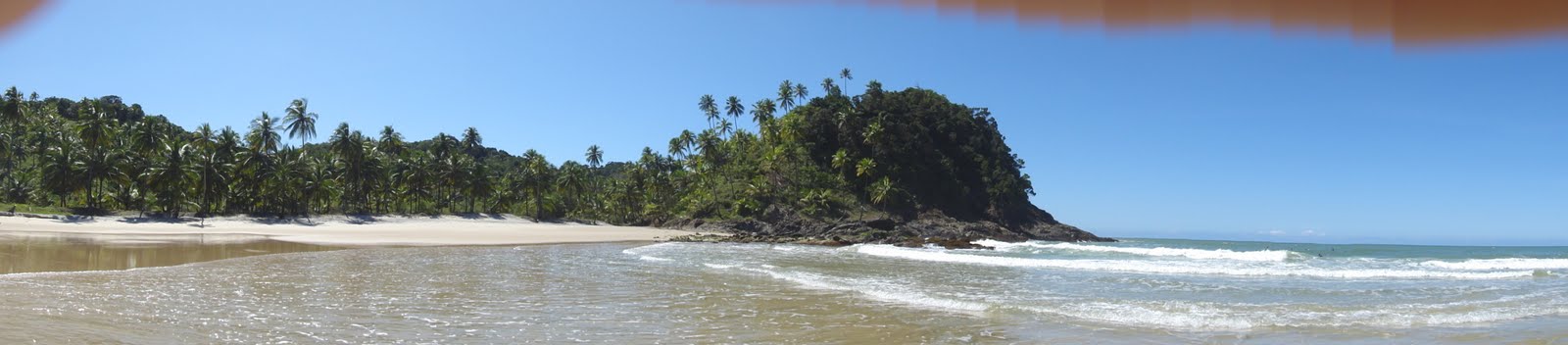
We waded through streams, cascading waterfalls and cliff-hugging paths until we finally reached our destination. An incredibly green, palm-tree covered isolated beach. 


Where we spent the day sipping from coconuts on the white sand whilst staring in awe at the clear, blue sea and surrounding lush jungle. 


The Road to Itacare

I was sad to be leaving busy, bustling Rio De Janeiro but looking forward to some beach time in the north of Brazil. Nikki and I dragged our heavy backpacks to the bus station at 7pm, bought our overly-expensive tickets and prepared for our 16 hour bus journey, which we would later discover was in fact, a 23 hour bus journey. The journey through the night was painfully long and uninteresting. However, as the sun bagan to rise at 5.30am the sky turned dusky pink displaying tropical jungle, emerald green mountains and clear blue streams. A beautiful, picturesque view to wake up to. We finally arrived at Ilheus bus station at 7pm, 24 hours after we had left our hostel in Rio De Janeiro. We frantically ran through the bus station looking for the ticket office as we had to make sure we got onto the last bus heading towards Itacare otherwise we would be spending the night in Ilheus bus station. We didn´t think we would make it.

Luckily, we got our tickets in time and boarded another uncomfortable bus, thankfully only a 90 minute journey this time. We eventually arrived in pretty Itacare where we were greeted with cobbled streets, cute cafes, fairy-light covered bars and coconut covered beaches. Exactly what we needed after our long 25hour journey!

Thursday, 4 August 2011

Brazilian Football

Football is Brazils number one passion, closely followed by samba, so I couldn't leave Rio without experiencing a football match with the locals.We got tickets to see Fluminense, from Rio, versus Ceara, from the north of Brazil, at the Olympic stadium right in-between two rival favelas. We followed the stream of green, red and white and the gigantic Fluminense flags. We entered the stadium that could have been mistaken for a samba club as the Fluminense fans played steel drums to football chants whilst others danced and jumped along. The Fluminense crowd where very welcoming of us 'gringos', encouraging us to sing and dance along with them to support their beloved team. It was an incredibly lively atmosphere. The drums could be heard throughout the entire game and even when it wasn't looking good for Fluminense, spirits were high and the drums continued to play. And when a red card was given to a Ceara player, the drums went wild! When Fluminense scored, the celebrations were spectacular.

As the sun set over the stadium, the final whistle was blown, 4-0 to Fluminense. The Rio crowd went home a very happy bunch and the drums could still be heard even after we had left the stadium.

Monday, 1 August 2011

The Favelas of Rio

There are 3 million people in Rio De Janeiro living in the small shanty houses of the favelas. I thought it would be interesting  to visit one of them, so we booked ourselves onto the favela tour with Be-A-Local tour company, boarded a motorbike and set off to one of the biggest favelas in Rio, where a massive 85% of buisness is illegal.


As we quietly tip-toed around the narrow alleyways of the favela, carefully trying to stay out of everyones way, the locals politely greeted us as gringos-the tourists. Children ran around the maze-like streets care-free and wearing a smile, and the adults walked around care-free and wearing guns. I was surprised at how big the favela was and how self contained it is with small markets, shops, a day care centre and many many bars. There is no need for people to leave the favela and I imagine many of the children never have.

The favela is surrounded by beautiful mountains and overlooks Ipanema beach where the rich and glamourous live in their high rise apartments. Just another reminder that this a city of extreme contrasts.

The government have recently built a school, sports centre and samba school on the outskirts of the favela as an incentive for parents to encourage their children to go to school rather than work or beg for money. We were lucky enough to experience  some of the children practicing samba in the streets of the favela using tins and wooden sticks. The most impressive part of this 5-man band is the 3 year old child samba dancing. Check out the video: